Pseudomonas aeruginosa is a bacterium that can take hold in the lungs of people with cystic fibrosis (CF), leading to persistent infections that are difficult to treat. In many cases, antibiotics alone are not enough to fully clear these infections.
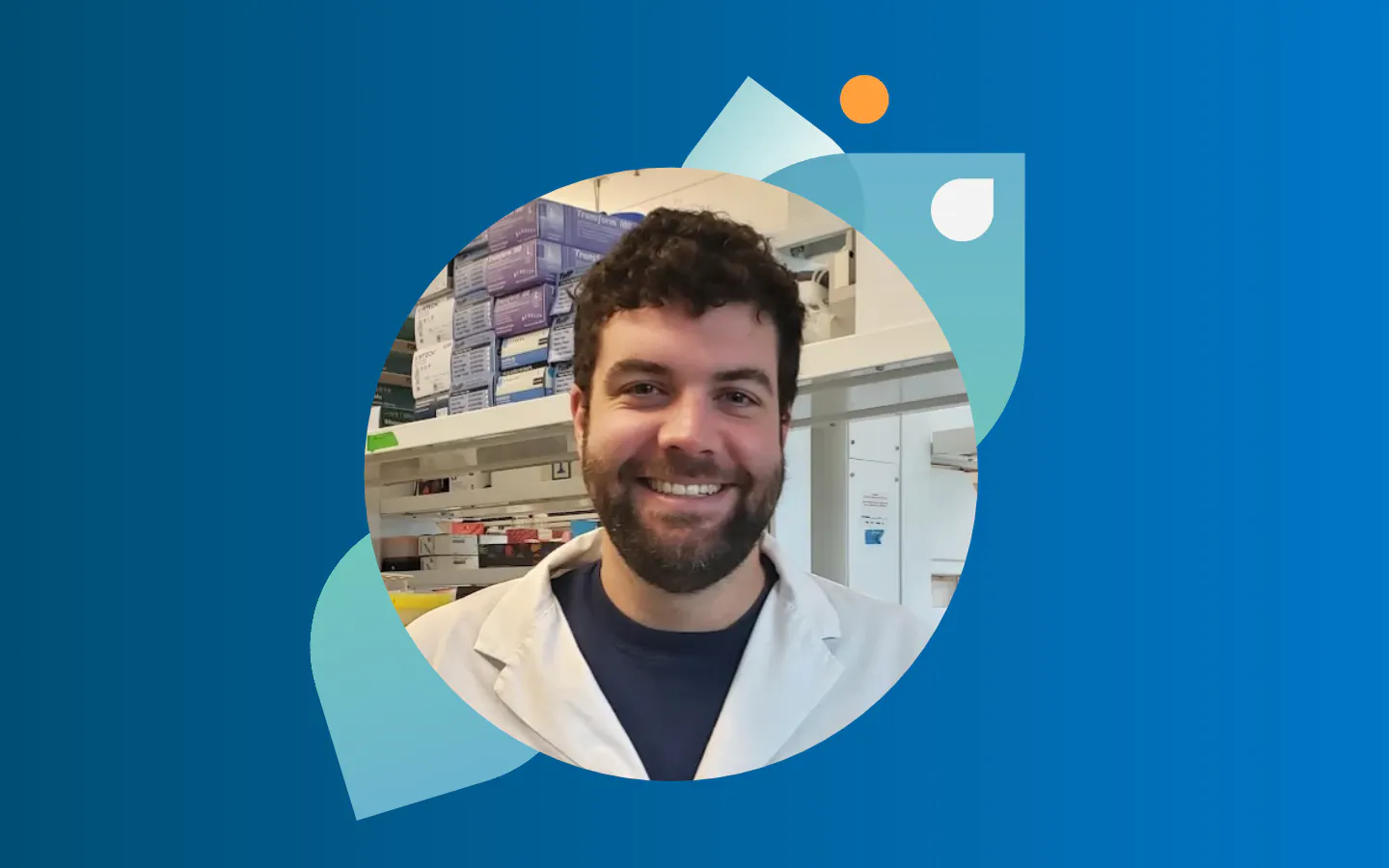
Dr. Justin Di Trani is working to change that. His research focuses on finding new ways to weaken these bacteria, making them easier to eliminate and helping improve outcomes for people living with CF.
An Early Career Investigator and Assistant Professor at the University of Alberta, Dr. Di Trani trained at McGill University, SickKids, and the University of Toronto, before moving to the University of Alberta in 2024 to access specialized microscopes and equipment that are essential for studying the bacteria that live in CF lungs.
From seed grant to Early Career Investigator award
At the core of Dr. Di Trani’s research is a focus on how Pseudomonas aeruginosa powers itself. Because its engine runs differently than the ones in our own cells, it may be possible to stall it with a treatment that leaves human cells untouched.
His team has already spotted several weak spots in the Pseudomonas engine and started finding compounds that could interfere with them.
“We have a number of potential targets,” he says. “We're trying to decipher which ones are the most promising. With the Cystic Fibrosis Canada Seed Grant, we were able to start discovering compounds.”
He credits the Seed Grant with helping him launch the work that led to his current research program and Early Career Investigator Award.
One key discovery from his research is that Pseudomonas aeruginosa behaves very differently depending on its environment, particularly the amount of oxygen available. While bacteria are typically studied under normal oxygen levels in the lab, oxygen levels in the CF lung are much lower during an infection.
This means that treatments that appear effective under standard conditions may not work the same way in the body. To address this, Dr. Di Trani and his team are developing new lab models that better mimic the environment of the CF lung, including lower oxygen levels and more realistic nutrient conditions.
“We’re making a media that mimics the CF lung to grow the bacteria,” he explains, “so that they grow the same way and the things we're doing to inhibit them would also work in the lung.”
The Early Career Investigator Award is now helping his lab expand these efforts and build on its early discoveries.
“We’re growing quickly,” he adds, “thanks to funding from places like Cystic Fibrosis Canada.”
Bridging different areas toward a common goal
When asked what advice he would give to researchers who want to make a real-world impact, his answer is clear: “Get collaborative.”
“I don't think any one person could do that alone,” he says.
To move his research forward, Dr. Di Trani works closely with experts across disciplines. His collaborators include Dr. Wael Elhenawy, a microbiology expert at the University of Alberta, as well as a medicinal chemist based in Germany. More recently, he has also begun working with researchers who specialize in machine learning and artificial intelligence.
By bringing together this range of expertise, from basic science to drug design, his team is working toward a shared goal: developing more effective treatments for CF lung infections.
Within his own lab, Dr. Di Trani fosters that same collaborative environment. His team of students each studies a different part of the bacteria’s energy system, which he describes as a series of “molecular machines.”
“They're really big, complicated molecular machines,” he explains. “There's a number of ways you could jam up the machine.”
Because each student targets a different part, the chances of finding a way to shut it down increase, and the projects often overlap.
“The projects end up melding together a bit because something one person discovers is actually targeting the other person's part,” he says. “It makes for a nice collaborative environment within the lab."
While this work is still at an early stage, it holds real promise. Eventually, these discoveries could lead to treatments that make infections easier to control and improve quality of life for people with CF.